Scenario Lifesavers: When Simulation Goes Sideways
This is a feeling familiar to all sim educators.
You've designed the perfect simulation scenario, every detail considered, every learning outcome mapped.
Then reality kicks in.
Your participants veer wildly off script, technical issues arise, or basic skills prove unexpectedly challenging. Welcome to the world of scenario lifesavers - the art of salvaging learning opportunities when things don't quite go to plan.
The Theory Bit
Dieckmann et al. introduced the concept of scenario lifesavers back in 2010, describing them as "interventions before and during simulation scenarios that allow creation and use of relevant learning opportunities, even if unexpected events happen."¹ These interventions generally work in two ways:
- Bringing participants back to the planned scenario
- Adapting the scenario to fit participants' actions
What's particularly clever is how these can be implemented either from within the scenario's "fiction" or by stepping outside it entirely.
The Anatomy of a Lifesaver
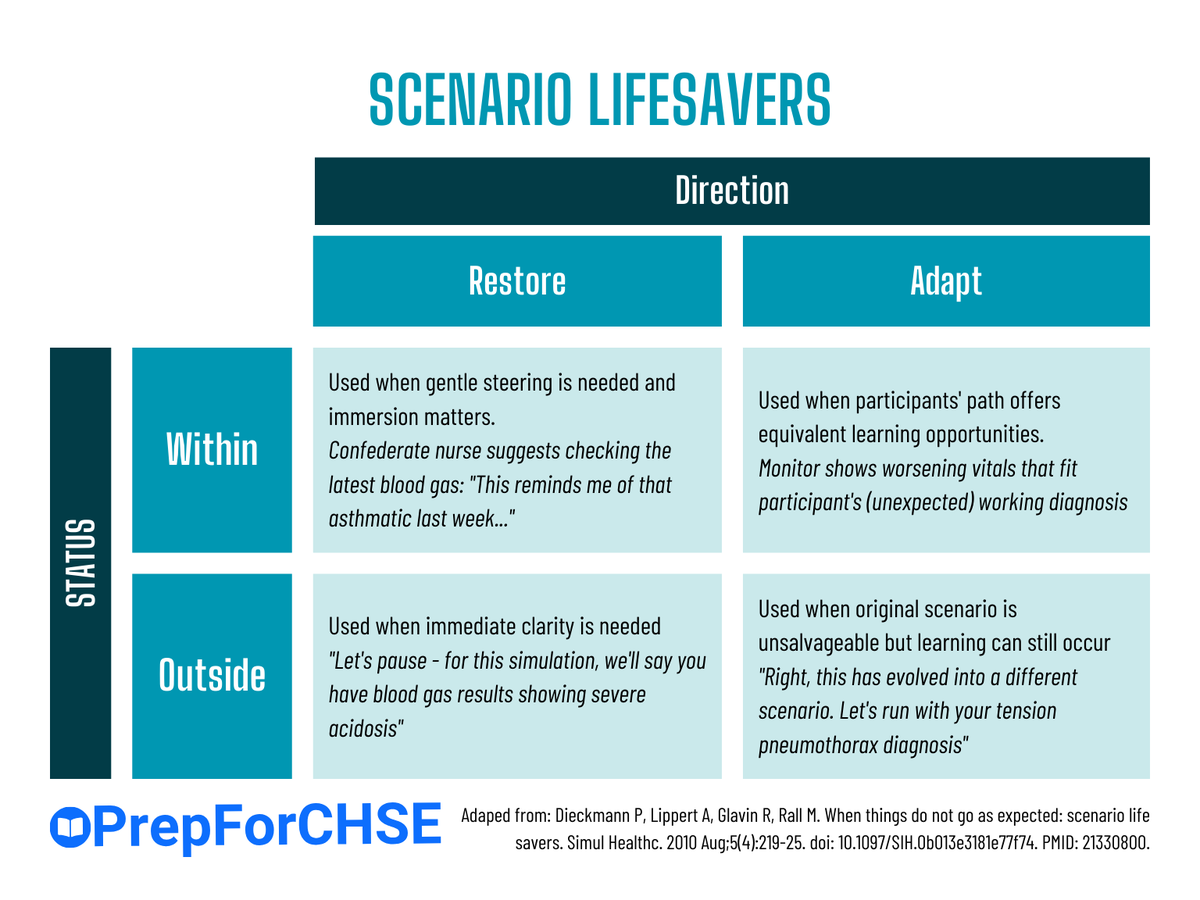
Let's get a bit more technical about the different types of scenario lifesavers. Dieckmann et al. describe two key dimensions: direction and simulation status.
Direction
This refers to whether you're trying to:
- Restore: Get the scenario back on its intended track
- Adapt: Change course to work with where participants have taken things
Simulation Status
This is about whether your intervention comes from:
- Within: Working inside the scenario's "fiction"
- Outside: Breaking the fourth wall
When you combine these, you get four distinct approaches:
Within-Scenario Lifesavers: The Art of Subtlety
Within-scenario lifesavers are rather like good theatrical improvisation. They require quick thinking and careful execution to maintain the fiction. Some elegant examples:
- Having a confederate take a phone call: "Yes doctor, their previous admission in February showed similar gas patterns..."
- Using equipment limitations: "The portable X-ray is busy in ED, but should be here in 5 minutes" (buying you time to reset)
- The arriving consultant: "I was just passing and heard you might need a hand..."
Outside-Scenario Lifesavers: Clean Breaks
Sometimes, you just need to step out of the fiction. These interventions are clear and direct:
- "Let's pause here and clarify something..."
- "For simulation purposes, we'll say that..."
- "The monitor isn't displaying correctly, but the patient's saturation is 88%"
Choosing Your Approach
The art lies in choosing the right type of lifesaver for the situation. Consider:
- What are the learning aims and objectives, and how can they best be achieved?
- How will the choices affect participant psychological safety?
- How much time do you have?
- How crucial is maintaining the fiction?
- What's the participant's current cognitive load?
Sometimes a subtle within-scenario nudge is perfect; other times you need the clarity of stepping outside. The key is having both tools in your toolkit and knowing when to use each.
Real World Examples
Let's tackle some examples:
Case 1: The Impossible Cannulation
Scenario: Management of shock, but no one can get IV access
Learning outcomes: Decision making in shock - vasopressor choice, fluid resuscitation
Possible lifesavers:
- Within scenario: Have the confederate nurse mention "The IO kit just arrived from ED"
- Outside scenario: "For the purposes of this simulation, assume IV access has been obtained"
The key question here is whether IV cannulation is integral to your learning outcomes. If it's about decision making rather than procedural skills, don't let technical challenges derail the entire scenario.
Case 2: The Misinterpreted ABG
Scenario: Severe asthma, but participant misreads a blood gas indicating the patient is in a life-threatening condition
Learning outcomes: Recognition and management of life-threatening asthma
Possible lifesavers:
- Within scenario: Have a colleague arrive and say "Wow, that pCO2 is concerning"
- Outside scenario: Brief pause - "Let's review this blood gas together before continuing"
This one's trickier. The interpretation is crucial to the learning outcomes. A gentle nudge within scenario might work, but if not, consider a brief timeout to ensure learning isn't compromised.
The "What Would You Do?" Challenge
Here's a scenario for you to ponder: You're running a cardiac arrest simulation. The learning outcomes focus on team dynamics and leadership. Five minutes in, your high-fidelity mannequin's chest compression sensor fails. What's your move?
Would you: A) Stop and restart with a lower-fidelity mannequin B) Continue without feedback on compression quality C) Something else entirely?
Some Guiding Principles
When deciding whether to implement a lifesaver:
- Always consider your learning outcomes first
- Think about psychological safety of your participants
- Choose the least disruptive intervention that will work
- Remember that perfect simulation isn't the goal - learning is
- Document what worked (and what didn't) for next time
The Bottom Line
Scenario lifesavers aren't about creating perfect simulations - they're about preserving learning opportunities when things go awry. The key is preparation, quick thinking, and always keeping your learning outcomes in focus.
¹ Dieckmann P, Lippert A, Glavin R, Rall M. When Things Do Not Go as Expected: Scenario Life Savers. Simul Healthc. 2010;5(4):219-225.
Want more simulation education content? Check out our CHSE question bank at PrepForCHSE.com
Written by Matt Bowker
Dr. Matt Bowker is a simulation educator and with over a decade of experience in healthcare simulation across multiple continents and student groups.